
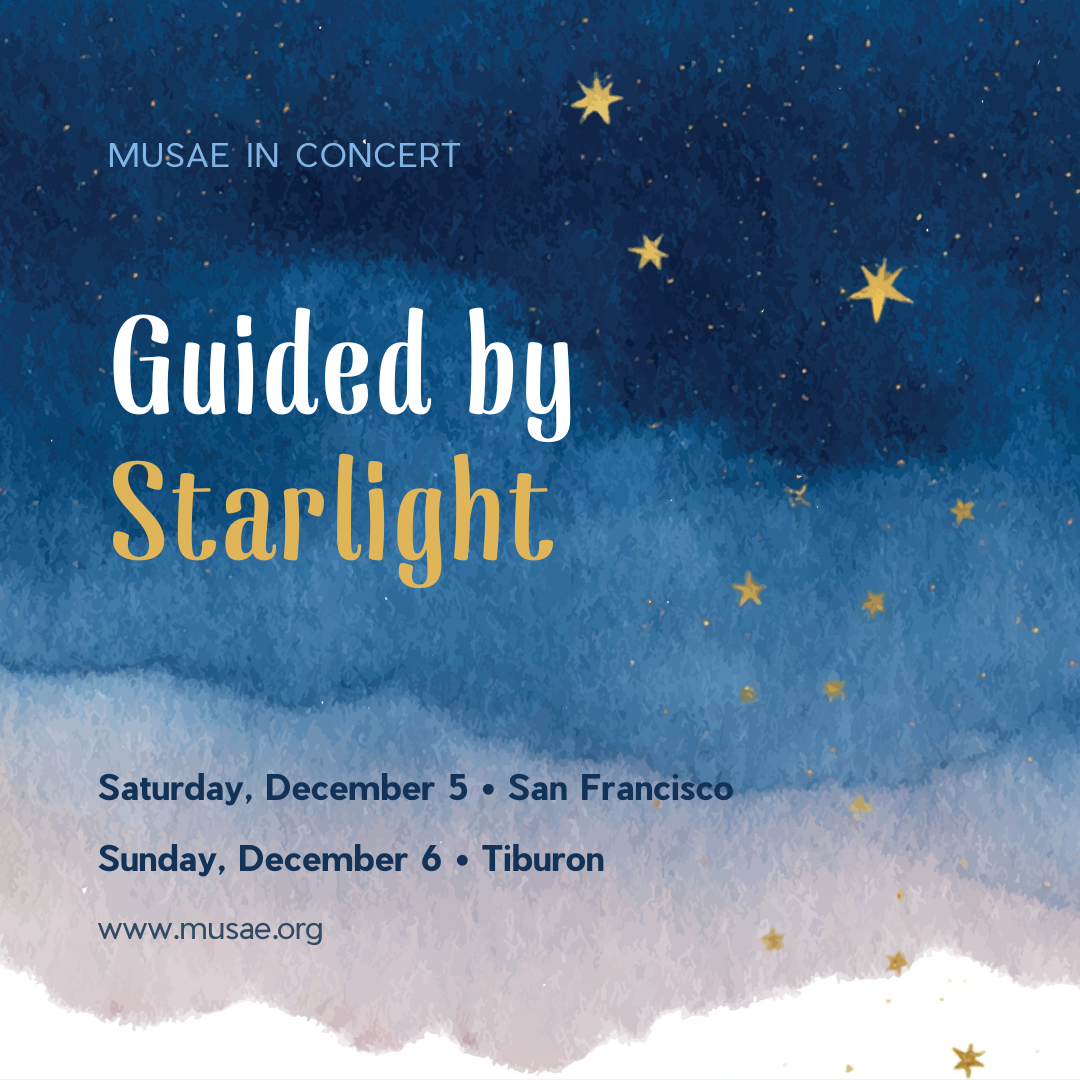
Saturday, December 5, 2026
4:00 pm
Noe Valley Ministry
1021 Sanchez Street, San Francisco
Sunday, December 6, 2026
1:00 pm & 4:00 pm
Old St. Hilary's Landmark
201 Esperanza Street, Tiburon

Dear Concert Patrons,
During the longest and darkest nights of the year, we look up. For centuries, travelers and seekers have trusted the stars as fixed points in a changing world, steady lights to steer by when the path ahead disappears. Guided by Starlight gathers songs for the moments when the way forward is uncertain, and asks what helps us find our bearings.
The stars in these songs are rarely just stars. They stand for the things we hold most dear, such as love, faith, courage, compassion, and the people who keep us company in the dark. Like the stars, our values often shine most clearly when the night is long. They may not light the whole road, but they show us which direction to walk.
The program begins in the hush of the winter solstice and far from home, with wanderers and exiles praying for shelter. It moves through the night and the unknown, discovering stillness, love, and holiness, and follows a guiding star toward the gentle light of evening. It arrives at last in a meadow of blossoming stars, where the stars themselves seem to sing. In two pieces you will also hear words of our singers’ own, verses they have written and words chosen in the moment, small reminders that each of us carries a light of our own.
Thank you for joining us. Whatever you are navigating this season, we hope you find a steady light to guide you, and that you can also be that light for someone else.
With gratitude,

Elizabeth Kimble Artistic Director, Musae
GUIDED BY STARLIGHT
Elizabeth Kimble, Artistic Director
I.
WINTER SOLSTICE
WORLD PREMIERE (SSAA arrangement)
Text and music by Naomi LaViolette (living composer)
II.
ESTI DAL
Traditional Hungarian folk song, arr. Zoltán Kodály (1882–1967)
POOR WAYFARING STRANGER
Traditional American folk hymn, arr. John M. Dye (1875–1957), additional lyrics by Musae singers
THE GATE OF THE YEAR
Eleanor Daley (b. 1955), Text by Minnie Louise Haskins (1875–1957)
III.
IT’S STRANGE ABOUT STARS
Melissa Dunphy (b. 1980), Text by Lola Ridge (1873–1941)
INVITATION TO LOVE
Jeremy Beck (b. 1960), Text by Paul Laurence Dunbar (1872–1906)
LOCUS ISTE
Daniel McDavitt (b. 1979), Text from the Latin gradual for the dedication of a church, interwoven with words by singers of the Brigham Young University Women’s Chorus
IV.
BRIGHTEST AND BEST
Traditional Appalachian folk hymn, arr. Jerome Epstein (1941–2015) and Elizabeth Kimble (b. 1986), Text by Bishop Reginald Heber (1783–1826)
SVETE TIKHIY
Pavel Chesnokov (1877–1944), Text from the Russian Orthodox All–Night Vigil service
V.
MEADOWS OF HEAVEN
Gerda Blok–Wilson (b. 1955), Text by Henry Wadsworth Longfellow (1807–1882)
STARS
Ēriks Ešenvalds (b. 1977), Text by Sara Teasdale (1884–1933)
SPARK (TO MUSIC)
Eric William Barnum (b. 1979), Text by Maude Gordon–Roby (1868–1927)
Program Notes
I.
Portland–based composer Naomi LaViolette wrote Winter Solstice after a family ritual in the winter of 2021, when her teenage daughter Lucia led them in a solstice ceremony at the close of a dark and difficult year. As they wrote down their memories and released them into the fire, LaViolette was overcome with emotion and then filled with awe and peace, and that experience became the words of this piece. First composed in 2022 for mixed voices, Winter Solstice was arranged for treble choir at Musae’s commission, and this concert marks the world premiere of the SSAA version. Its third line, “Guided only by starlight,” sets the theme for our program. The music moves from the hushed stillness of its opening, through the swelling resolve of “and then we let it burn,” to a closing “Rest now” that fades to the softest sound of the piece. LaViolette hopes the work can draw people of any faith, or none, into a shared moment of reflection and renewal.
II.
Zoltán Kodály spent much of his life collecting and championing the folk songs of Hungary. In Esti Dal (Evening Song), composed in 1938, he sets a folk text in the voice of a wanderer far from home. Resting at the edge of a forest with a cloak for a pillow, the singer folds their hands and asks God for shelter, weary of a life of exile in a foreign land. Kodály lets the prayer unfold simply over a soft hummed accompaniment, and the piece closes with a hushed blessing for a good night. It remains one of his most frequently sung choral works, cherished in Hungary and around the world as an evening prayer.
Poor Wayfaring Stranger is one of the best–known American folk hymns, the song of a weary traveler looking past hardship toward a home “over Jordan.” Its origins are uncertain, with likely roots in African American spirituals, and its words appeared in print as early as 1858. The version we sing comes from John M. Dye, an Alabama singing–school teacher and prolific gospel songwriter who harmonized the tune in 1935 for The Sacred Harp, the tunebook at the heart of a shape–note singing tradition still practiced across the American South. Dye places the melody in the tenor line and surrounds it with strong countermelodies in the other voices. Our performance draws on two practices common to this piece. First, as many treble choirs do, we raise the tenor and bass lines an octave, drawing the voices close together and letting them cross. Fragments of different parts then weave into a new composite melody, an aural illusion of a single tune that no one part actually sings. Second, like generations of musicians who have adapted this song to their own lives, Musae’s singers have written verses of their own, which follow the traditional verses below.
As Britain faced its first Christmas of the Second World War in 1939, King George VI closed his Christmas broadcast with the opening lines of “God Knows,” a little–known poem by Minnie Louise Haskins, a lecturer at the London School of Economics. Her words offered comfort to a nation entering an uncertain darkness, and they have been treasured ever since. Canadian composer Eleanor Daley sets this same opening passage, rather than the full poem, in The Gate of the Year. A solo voice first asks for a light to guide the way, and the choir answers with shimmering echoes of “Lux aeterna” (eternal light). The full choir then takes up the story, growing to a strong, confident “Go out into the darkness” before trusting itself to go “gladly into the night.” The piece ends as it began, with soft calls of “Lux” fading into silence.
III.
Australian–born composer Melissa Dunphy has set several poems by Lola Ridge for treble choir. Ridge was an Irish–born poet who grew up in New Zealand and later became a fiercely radical voice in early twentieth–century New York. It’s Strange About Stars draws on Ridge’s 1920 collection Sun–Up, a sequence of poems that revisits the world from a child’s point of view. Here the child discovers that the stars ask her to be still, and that their light, unlike the sun’s, sinks in without harm and leaves her feeling “cleaner’n water.” Dunphy dedicates the piece “for all the survivors” and describes it as a song not only about stars, but about the hope and healing they represent. Listen for the hushed, wondrous opening, the great swell as the starlight “washes all over you,” and the gentle return to stillness at the close.
The poet Paul Laurence Dunbar was born in Dayton, Ohio, to parents who had been enslaved. He became one of the first African American poets to win national acclaim, writing celebrated verse in both standard English and dialect before his death at just 33. His poem welcomes love in every season and every mood, by night or by day, in grief or in joy, in summer’s glow or winter’s snow. American composer Jeremy Beck wrote Invitation to Love in Louisville in the autumn of 2020, and it won first prize in the 2021 King’s Singers New Music Prize. His setting is calm and lyrical, passing each “Come” gently among the voices over soft humming before they gather on every warm “welcome.” Written during the COVID–19 pandemic, when gathering together was hardly possible, the piece offers an open–hearted welcome that carries particular tenderness.
Locus Iste joins one of the oldest texts in the choral tradition with words written by contemporary singers. The Latin gradual, sung at the dedication of a church, declares a place to have been made by God. Composer and conductor Daniel McDavitt wrote the piece on commission from the Barlow Endowment for Music Composition, and it was premiered by the Brigham Young University Women’s Chorus. He paired the ancient Latin with survey responses from members of that choir, each beginning with the words “I feel.” Scored for two choirs, the piece sets one choir quietly repeating “locus iste” beneath the other, which builds from “I feel peace” to “I feel like God is one with me.” Near the end, singers repeat fragments freely at their own tempi, choosing their own words, so the closing texture is different in every performance.
IV.
Brightest and Best pairs an Epiphany hymn by the English bishop Reginald Heber, first published in 1811, with a melody shaped by generations of singers in the American South. The tune is a variant of “Star in the East,” a shape–note hymn passed down orally through the Ritchie family of Kentucky, a family celebrated for preserving Appalachian song. Heber’s text calls on the brightest star of the morning to dawn on our darkness and guide the way to the newborn child. The arrangement is by Jerome Epstein, a folklorist, singer, and music director of the New York Revels, who set the hymn with a plainspoken solo opening that blossoms into full harmony. Musae’s Artistic Director Elizabeth Kimble has added a new setting of the final verse for three voices. Like the star it describes, the melody leads us forward through the darkness.
Svete Tikhiy (Gladsome Light) is one of the oldest Christian hymns still sung today. Originally written in Greek (Phos Hilaron), it was traditionally sung at the lighting of the evening lamps, as daylight faded and the community gathered to praise the light that does not set. In the Russian Orthodox Church it is a central moment of the All–Night Vigil. Pavel Chesnokov, among the most prolific Russian composers of sacred choral music, wrote hundreds of works for the church before Soviet restrictions on religion forced him to turn to secular music. In Svete Tikhiy, two choirs answer one another in warm, gently rocking phrases, joining for a radiant final cry that “all the world glorifies Thee” before settling into a peaceful close.
V.
Canadian composer Gerda Blok–Wilson found the inspiration for Meadows of Heaven during summers at Cape Egmont, Prince Edward Island. There she became fascinated by Acadian history and by Henry Wadsworth Longfellow’s Evangeline, the epic poem about a young woman separated from her beloved during the forced deportation of the Acadian people. Her lifelong search for him carries her across North America. Blok–Wilson sets just one image from the poem, as stars quietly appear in the night sky like flowers blossoming in a heavenly meadow. The music opens with a hushed, shimmering ostinato on “silently” before breaking into a playful dance on “meadows of heaven.” Near the end, each singer enters on her own and freely chants “one by one,” so the stars seem to appear one at a time.
Stars by Latvian composer Ēriks Ešenvalds sets a poem by Sara Teasdale, the American poet who won the first Pulitzer Prize for poetry in 1918. Teasdale’s speaker stands alone on a dark hill beneath a sky full of stars and comes away humbled to be a witness “of so much majesty.” Originally composed for mixed choir, the piece was later arranged for treble voices on a commission from the Japanese choir Regalo. Its most striking feature is the sound of tuned water glasses, which the singers play by circling a wet fingertip around each rim. The glasses create a glowing halo of sound that hangs beneath the voices like starlight.
Maude Gordon-Roby was a suffragist, lecturer, singer, and poet from Bristol, New Hampshire, who believed deeply in the healing power of music. Her poem To Music sends the poet’s weary heart soaring past angels and planets, praising music as the “language of my soul.” Composer and conductor Eric William Barnum set this text in Spark (To Music) for Cantemus, the treble choir of Iowa State University. Over a steady pulse of “fly” in the lower voices, the melody climbs toward the heavens, and in the final line, music itself becomes a “spark of the sky,” a star of its own. Small groups of singers break into loud whispers of “spark” that flicker through the texture like stars appearing in the night sky. The piece ends with a scattering of calls to “fly,” sending our journey by starlight out into the night.
Texts & Translations
-
Snow and shadow surround us
Earth is cold and still
Guided only by starlightDays overtaken swiftly by darkness
The trees sleep and the moon hidesThis Winter Solstice we take the time
To look inside our shadowsWe’re not afraid of our darkness
We’re not afraid of the hidden places in our heartsTears fall as we remember
We write it down, we hold it close
And then we let it burnWatch it turn to light in the fire
Release into the night
As it dies with the Earth we are reborn
We become barren to return to lifeRest now, and the Earth rests with you
-
Erdő mellett est vélëdtem,
Subám fejem alá tëttem.
Összetëttem két kezemet,
Úgy kértem jó Istenëmet:Én Istenëm, adjál szállást!
Már mëguntam a járkálást;
A járkálást, a bujdosást,
Az idegën földön lakást.Adjon Isten jó éjszakát,
Küldje hozzám szent angyalát:
Bátorítsa szívünk álmát;
Adjon Isten jó éjszakát.Beside the forest, evening overtook me,
I put my cloak under my head.
I folded my two hands together,
Thus prayed to my good God:My God, give me shelter!
I am weary of wandering;
Of hiding in exile,
A stranger in a strange land.May God grant me a peaceful night,
May he send his holy angel to me:
May it comfort the dreams of my heart;
May God give me a good night. -
I am a poor, wayfaring stranger,
While journ’ying through this world of woe,
Yet, there’s no sickness, toil nor danger,
In that bright land to which I go.I’m going there to see my Father,
I’m going there no more to roam;
I’m only going over Jordan,
I’m only going over home.I know dark clouds will gather o’er me,
I know my way is rough and steep;
Yet beaut’ous fields lie just before me,
Where God’s redeemed their vigils keep.I’m going there to see my Mother,
She said she’d meet me when I come;
I’m only going over Jordan,
I’m only going over home.[following verses written by Musae singers]
I feel the cold of every winter,
I feel the long years wearing thin;
Yet spring will come, the ice will splinter,
And warmer days come rushing in.I’m going there to meet my elders,
They’re waiting where the rivers flow.
I’m only going over Jordan,
I’m only going over home.I sense my future is in danger,
I feel my freedom slip away.
Yet I am strong, and I’m a fighter,
I’m holding on another day.
I’m going there to meet survivors,
They’ll understand where I come from,
I’m only going over Jordan,
At long last, I am at home. -
I said to the man who stood at the gate of the year,
“Give me a light that I may tread safely into the unknown.”Lux aeterna (eternal light)
And he replied,
“Go out into the darkness, and
put your hand into the hand of God.
That shall be to you better than light,
and safer than a known way!”So I went forth, and finding the Hand of God,
trod gladly into the night. -
It’s strange about stars...
You have to be still when they look at you.
They push your song inside of you with their song.
Their long silvery rays
sink into you and do not hurt.
It is good to feel them resting on you
like great white birds...
and their shining whiteness
doesn’t burn like the sun —
it washes all over you
and makes you feel cleaner’n water. -
Come when the nights are bright with stars
Or come when the moon is mellow;
Come when the sun his golden bars
Drops on the hay–field yellow.
Come in the twilight soft and gray,
Come in the night or come in the day,
Come, O love, whene’er you may,
And you are welcome, welcome.You are sweet, O Love, dear Love,
You are soft as the nesting dove.
Come to my heart and bring it to rest
As the bird flies home to its welcome nest.Come when my heart is full of grief
Or when my heart is merry;
Come with the falling of the leaf
Or with the redd’ning cherry.
Come when the year’s first blossom blows,
Come when the summer gleams and glows,
Come with the winter’s drifting snows,
And you are welcome, welcome. -
Locus iste a Deo factus est,
inaestimabile sacramentum.This place was made by God,
a priceless sacrament.I feel
I feel peace
I feel love
I feel heaven
I feel eternal
I feel complete
I feel serenity
I feel joy
I feel safe, at home, replenished, tranquil, and
untouchable
I feel arms wrapped around me
I feel solace for my soul
I feel like my worries and strife disappear
I feel peace for my anxious mind
I feel calm and overwhelmed with love
I feel healing and enduring hope
I feel strengthened and endowed with power
I feel like Heaven and Earth are one in me
I feel like God is one with me. -
Hail the blest morn! See the Great Mediator
Down from the regions of Glory descend!
Shepherds, go worship the Babe in the manger;
Lo, for a guard the bright angels attend.Brightest and best of the sons of the morning!
Dawn on our darkness, and lend us Thine aid;
Star in the East, the horizon adorning,
Guide where our Infant Redeemer is laid.Cold on His cradle the dew–drops are shining;
Low lies His bed, with the beasts of the stall;
Angels adore Him, in slumber reclining,
Wise men and shepherds before Him do fall.Brightest and best…
Say, shall we yield Him, in costly devotion,
Odors of Edom and off’rings divine?
Gems of the mountain and pearls of the ocean,
Myrrh from the forest and gold from the mine?Brightest and best…
-
Svete tikhiy, svyatyya slavy Bezsmertnago,
Ottsa Nebesnago, Svyatago, Blazhennago,
Iisuse Khriste!
Prishedshe na zapad solntsa,
videvshe svet vecherniy,
poyem Ottsa, Syna i Svyatago Dukha, Boga.
Dostoin yesi vo vsya vremena
pet byti glasy prepodobnymi,
Syne Bozhiy, zhivot dayay,
temzhe mir Tya slavit.O Gladsome Light of the holy glory
of the Immortal Father, heavenly, holy, blessed
Jesus Christ.
Now we have come to the setting of the sun
and behold the light of evening.
We praise God: Father, Son, and Holy Spirit.
For it is right at all times to worship
Thee with voices of praise,
O Son of God and Giver of Life,
therefore all the world glorifies Thee. -
Silently, one by one,
in the infinite meadows of heaven,Blossomed the lovely stars,
the forget–me–nots of the angels. -
Alone in the night
On a dark hill
With pines around me
Spicy and still,And a heaven full of stars
Over my head,
White and topaz
And misty red;Myriads with beating
Hearts of fire
That aeons
Cannot vex or tire;…The dome of heaven
Like a great hill
…and myriads with beating
Hearts of fire,
Heaven full of stars…
I know that I
Am honored to be
Witness
Of so much majesty. -
Fly where Melodies like lilies grow,
My weary heart is bending low;Fly higher yet to joyful realms above,
Where holy Angels dwell in love.Fly higher still and hear the Angel throng
And bring to me their Glory–song:Music, thou and I above the World
May dwell where heaven with shining song is pearled!While Sun and Moon and all the planets roll
I’ll love thee, Music, language of my soul!Music–lark from on high, song that doth fly, Spark of the sky!
Artist Bios
Elizabeth Kimble (she/they) is a conductor, composer, soprano, and psychotherapist whose music explores the sacred and psychological dimensions of human experience. Currently the Artistic Director of Musae, Elizabeth has also served as the Music Director of Tactus SF and Assistant Conductor of the International Orange Chorale of San Francisco. A versatile vocalist, Elizabeth has performed as both a soloist and ensemble member with many distinguished choral groups, including the San Francisco Symphony Chorus, Cappella SF, Gaude, Clerestory, Volti, and the California Bach Society. Their compositions have been performed by the Swedish Radio Choir, Cappella SF, and SF Sound, and some of their liturgical music is published by Selah. She holds a MM in Music Composition from the San Francisco Conservatory of Music, dual BMs in Music Composition and Vocal Performance from Baldwin-Wallace College Conservatory of Music, and an MA in Counseling Psychology with an emphasis in Depth Psychology from Pacifica Graduate Institute. In addition to their musical endeavors, Elizabeth practices as an Associate Marriage and Family Therapist. Learn more at elizabethkimblemusic.com.
Musae is a treble vocal ensemble based in San Francisco. Founded in 2004, the group takes its name from the original "ladies of song," the classic nine Muses of Greek mythology. The singers are classically trained and have the flexibility to sing a wide range of genres and vocal styles based on the aesthetic demands of the repertoire. Led by Artistic Director Elizabeth Kimble, Musae functions as a musical collective in which each singer actively contributes to the artistic process. Primarily performing from memory and without a conductor, Musae creates an intimate concert environment where singers connect deeply with one another and the audience through direct engagement and intuitive responsiveness.
Allison Lynk
Amy Strauss
Barrie McClune
Caitlin Dodd
Carolyn Mortell
Christine Ensley
Danielle Schickele
Kate Sommer
Katie Innes
Kim McClain
Kirstin Cummings
Lauren Schwartz
Michela Macfarlane
Rachel Herbert
Sabrina Adler
Teresa Newmark
Valerie Moy
Musae Board of Directors
Elizabeth Stumpf
Erika Anderson
Katie Innes
Kirstin Cummings
Laney McClain Armstrong
Lynne Carmichael
Matthew Levine
Michela Macfarlane
Special Thanks
Allison Lynk
Blake Williams
Brent Williams
Caitlin Dodd
Dan Sommer
David Gotz
Kate Sommer
Katie Innes
Patricia Kristof Moy
Susan St. Martin
Sarah Lightfoot
Zach Miley
Thank you to our patrons for their in-kind and charitable contributions given between November 15, 2025 and November 15, 2026
🎵 Crescendo Club monthly donors
CELESTIALS ($2,500 AND ABOVE)
🎵Colleen O’Hara and Brendan Downs
Henry W. and Nettie Robinson Foundation
MAJOR GODS ($1,000 AND ABOVE)
Allison Lynk
🎵Carolyn Mortell
Chesley Herbert
Christopher Lewis and Ileana Riveron
Daniel Schickele
Deborah and Seán O'Hara
Elizabeth Stumpf
Erika Anderson and Dan Sommer
George and Nancy Montgomery Fund
Karin and Greg McClune
🎵Lynne Carmichael
Matthew and Monica Levine
Michael Gordon
Richard Dietrich
Steven Cummings and Ingrid Woods
MINOR GODS ($500 AND ABOVE)
Bev and Fred Lynk
Cynthia and Dave Blumgart
David and Amy Kalish
Kate Sommer
🎵Kenneth K. Moy
🎵Kirstin Cummings
🎵Marques Short
Paul and Jane Mortell
MUSES ($250 AND ABOVE)
Anjali Jameson
🎵Barrie McClune and Ed Dietrich
🎵Ben Ross
Beth and Phillip Schlueter
🎵Caitlin and Martin Dodd
Cecily P. Burrill
Elizabeth Avakian
Elizabeth Kimble
Ellisha Blechynden
Emily Kusnadi
Jefferson Packer
Joyce Lin-Conrad and Mark Conrad
🎵Katie Innes and Baldvin Smarason
Kathy and Gary Holland
Kevin Frank and Abby Ramsden
Kim and Micah McClain
Kit Hodge
Lauren Schwartz
🎵Leslie Innes
🎵Lucas Morton
Marie Herbert
Michela Macfarlane and Brent Williams
Patricia Kristof Moy
Peter Locke
Sandra Schickele
Sydney Weaver
Teresa and Dan Newmark
SIRENS ($100 AND ABOVE)
Angela Murray
Beverlee Johnson
Ceil Scandone
🎵David Strauss
Debbie and Chuck Schwartz
Izabella Appadoo
Karen Ray Gibson
Katherine Robinson and Todd Rose
Kristin Krueger
Larry Ross and Linda Nussbaum
Linda Gallaher-Brown
Madison Tyler
Nicholas Brock Weininger
Sabrina Adler
Sherrie Hansen
Simon R Bare
Susan and William Lukens
Zac Rose
POETS (UP TO $100)
Alice Guittard
Anita Allardice
Ann Blake
Anonymous
Arianne Abela
Carol Heard
Chip and Melanie Hammond Clark
Cricket Handler
Danielle Schickele
Dee McDonough
Denise Spaulding
Devi Jameson
Dolores McDonough
Elizabeth Brashers
Elsa Townsend
Friend
Jo Burnett
Kate Sylvester
Katharine Kendrick
Katie Mitchell
🎵Laney and Josh Armstrong
Maggie Eggert
Mary Townsend
Patricia and Steve Dussair
Peter, Ellen, and Jiah Barnett
Rachel Herbert
Renee Witon
Sage Nelissen
Sharon Silva
Whitney Baron
CORPORATE GIFTS
Kaiser Permanente
Zendesk